
From crisis to confidence: what WindEurope Madrid 2026 signals for electrification and project delivery
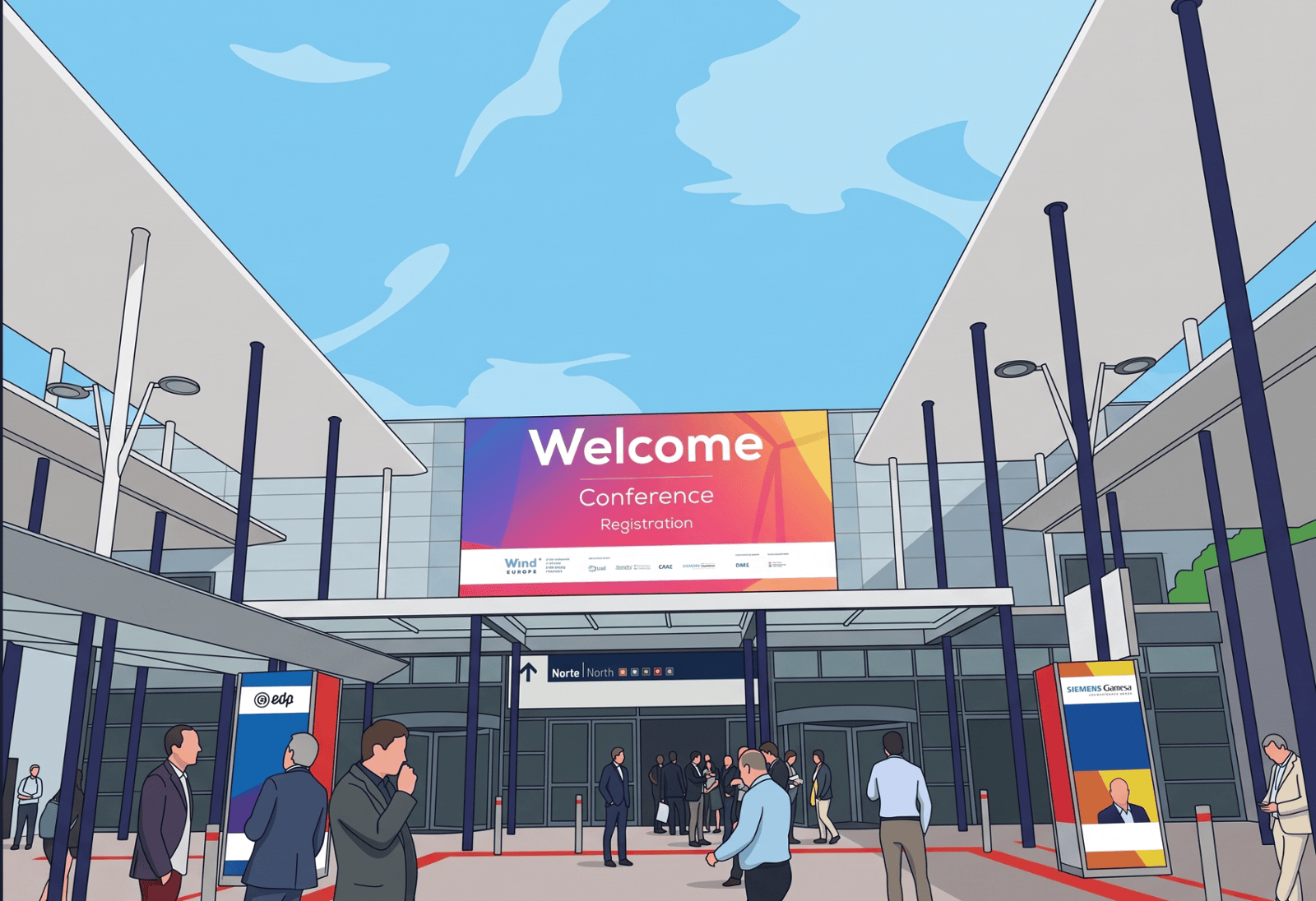
RUDORA GmbH (RdR) was pleased to be present at the WindEurope Annual Event in Madrid on 21 to 23 April 2026 and to reconnect with clients, colleagues and peers across the sector. The event reinforced a message that is becoming harder to ignore: if Europe wants stronger competitiveness, energy security and industrial resilience, it needs to electrify faster [1], [2].
In Madrid, WindEurope set out that message through the Madrid Call to Action, launched alongside Spanish Prime Minister Pedro Sánchez and European ministers. The emphasis was on execution. The call moved the discussion from ambition to delivery and laid out ten practical steps to accelerate electrification and wind deployment across Europe [1], [2].
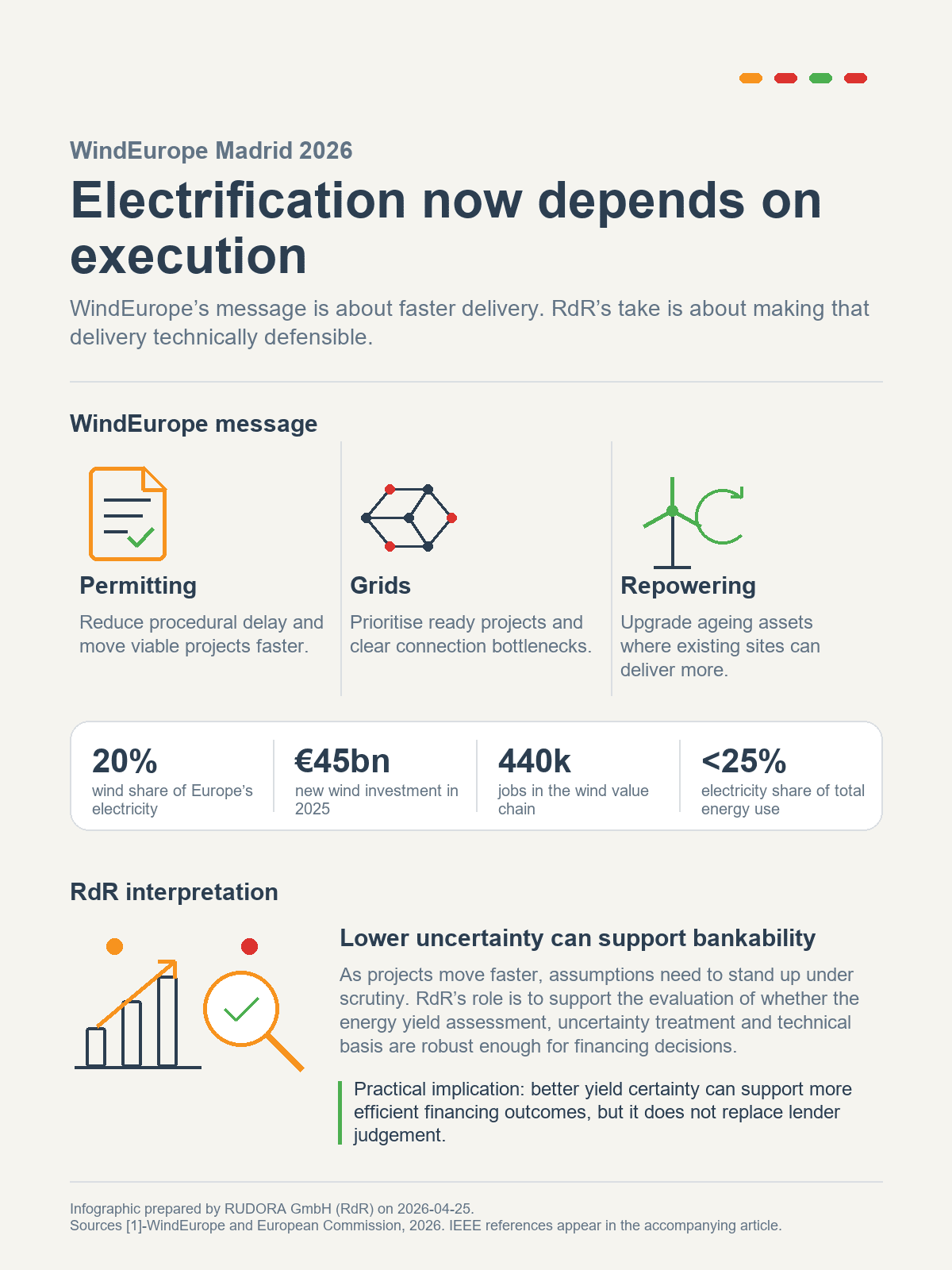
Those actions focus on the real bottlenecks: faster permitting, more effective wind auction design, repowering ageing wind farms, prioritising grid connections for viable projects, scaling up grid equipment manufacturing, increasing grid funding, and making electrification easier and more affordable for households, transport and industry [1], [4], [5]. That matters because Europe already has the core technologies and industrial capability. The issue is whether policy, infrastructure and project execution can move quickly enough to convert targets into delivered assets [1], [3].
The sector starts from a meaningful base. Wind already provides around one fifth of Europe’s electricity. The European wind value chain supports roughly 440'000 jobs, and the sector attracted €45 billion of new investment in 2025. At the same time, electricity still accounts for less than a quarter of total final energy use in Europe. That gap explains why electrification has moved to the centre of the competitiveness and security debate [1], [3].
For RdR, the significance is straightforward. The next phase of wind energy growth will not be delivered by policy intent alone. It will depend on projects that are technically robust, assumptions that are transparent, and decisions that remain defensible under scrutiny. In practice, that means disciplined project development, credible energy yield assessment, realistic uncertainty treatment, sound grid integration planning and technical review that stands up in front of lenders, investors and counterparties [4], [5]. This is where the market often becomes less comfortable. Faster permitting and stronger policy support are necessary, but they do not remove the need for bank-grade technical discipline. As projects move through increasingly congested grids, tighter auction conditions and more demanding financing environments, weak assumptions are exposed more quickly. A market that wants to build faster still needs evidence, traceability and independent technical challenge [4], [5].
That is also why events like WindEurope still matter. They bring policy, industry and project reality into the same room. Beyond the formal announcements, they help test whether the market is aligning around workable solutions or simply repeating familiar ambitions. In Madrid, the signal was more practical than rhetorical: Europe does not lack the need, the technology or the strategic rationale. It needs better execution across permitting, grids, repowering and electrification [1], [2], [3], [4], [5].
The Madrid Call to Action is therefore useful not because it introduces a new narrative, but because it sharpens the delivery agenda. Faster permitting, stronger grids, better investment conditions and practical electrification measures are not side issues. They are central to whether Europe can convert energy transition goals into operating projects and reliable supply. RdR was glad to be part of the discussion in Madrid and to see the sector pushing for a more delivery-focused approach [1], [2].
References
[1] WindEurope, “WindEurope 2026: From crisis to confidence,” 2026. [Online]. Available: https://windeurope.org/news/windeurope-2026-from-crisis-to-confidence/
[2] WindEurope, “WindEurope Annual Event 2026 in Madrid,” 2026. [Online]. Available: https://windeurope.org/annual2026
[3] European Commission, “Electrification,” 2026. [Online]. Available: https://energy.ec.europa.eu/topics/eus-energy-system/electrification_en
[4] WindEurope, “Grids are crucial to make Europe more competitive and energy secure,” 2026. [Online]. Available: https://windeurope.org/news/grids-are-crucial-to-make-europe-more-competitive-and-energy-secure/
[5] WindEurope, “Repowering wind farms: a major opportunity for Europe,” 2026. [Online]. Available: https://windeurope.org/news/repowering-wind-farms-a-major-opportunity-for-europe/